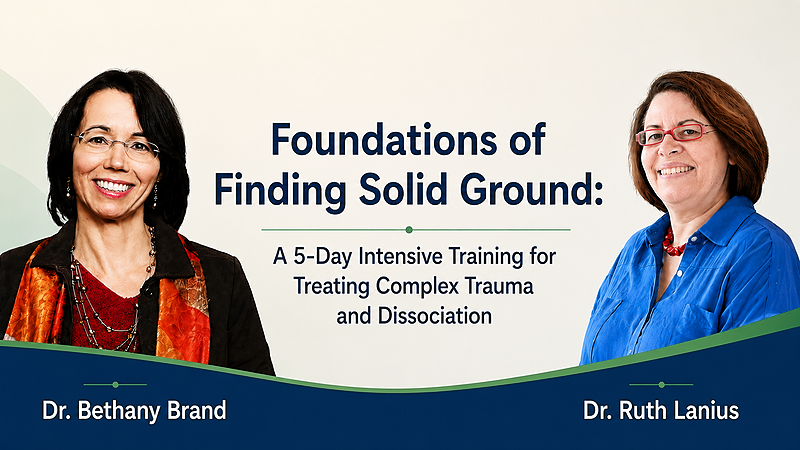
Understanding Dissociative Self-States
Session 4 of the 5-Day Intensive Training for Treating Complex Trauma and Dissociation
Have you ever found yourself wondering why a client repeatedly returns to abusive relationships, suddenly withdraws from connection, becomes highly self-critical, or engages in behaviors that seem to undermine their own safety and recovery?
These patterns can be confusing, frustrating, and difficult to address, even for experienced trauma therapists.
This session explores one of the most important yet often misunderstood aspects of complex trauma treatment: the relationship between dissociative self-states, attachment patterns, and survival-based behaviors. Participants will learn how trauma shapes the ways clients relate to themselves and others, often leading to recurring interpersonal patterns that interfere with treatment, relationships, and recovery.
Building on the foundations established in the previous sessions, clinicians will learn to recognize common relational survival strategies, including fight, flight, freeze, submission, identification, and appeasement, and understand how these patterns emerge as adaptive responses to overwhelming experiences. The session will also provide practical guidance for working with dissociative self-states, helping clinicians respond more effectively to angry or critical parts, traumatized younger parts, and passive or helpless parts that often drive behavior outside of conscious awareness.
Particular attention will be given to understanding the hidden protective functions of high-risk and self-destructive behaviors. Rather than viewing these behaviors as resistance or noncompliance, participants will learn how to uncover the survival needs they serve and use this understanding to facilitate meaningful and lasting change.
Through engaging clinical demonstrations and role plays, participants will observe practical interventions for working with dissociative self-states, reducing internal conflict, addressing self-defeating behaviors, and supporting clients who remain in abusive or unsafe relationships.
Clinicians will learn how to balance validation and compassion with strategies that promote greater safety, empowerment, and autonomy.
As with every session in the Finding Solid Ground program, these interventions can be seamlessly integrated into virtually any psychotherapy approach, providing clinicians with a flexible, evidence-informed framework for navigating some of the most challenging situations encountered in trauma treatment. Participants will leave with a deeper understanding of their clients' behaviors, greater confidence in working with dissociative self-states, and practical tools for helping clients move toward safer relationships, increased self-understanding, and lasting recovery.
This course is meant to be completed within the 5-part series not as a stand-alone course.
Recognize common trauma-related relational patterns in highly dissociative clients, including fight/avoidance, fight/interruption, freeze (tonic immobility), dissociation, submission, identification, and appeasement.
Identify and effectively work with common dissociative self-states, including angry or critical self-states, traumatized younger self-states, and passive or helpless self-states.
Understand the protective functions of high-risk, unsafe, and self-defeating behaviors and apply interventions that promote safer alternatives.
Implement practical strategies for supporting clients who remain in abusive, coercive, or unsafe relationships.


5 CE credits available for live attendance & recorded sessions
Bridgepoint Psychology Center (BPC) is co-sponsoring Finding Solid Ground and is approved by the American Psychological Association to sponsor continuing education for psychologists.
You must be in attendance for the full live program or watch the full recording and pass a quiz to receive CE credit. Partial credit will not be available. BPC maintains responsibility for this program and its content.
Please check with your governing board to verify your continuing education license requirements. For additional information regarding CEs, email: [email protected]
Yes, our courses are through APA for continuing education credits. Please check each course description for specific accreditation details.
Upon successful completion of the course and any required assessments, you'll be able to download your CE certificate directly from your account under the "Completed Courses" section.
We provide a CE certificate that includes all necessary details (course title, hours, provider information). Please submit this certificate according to your licensing board’s requirements. It's important to verify your board's guidelines to ensure proper credit reporting.
180 days
While our courses are APA, CE credit requirements vary by state and licensing board. We recommend checking with your specific licensing board to ensure our courses meet their criteria.
You will need a computer or mobile device with internet access, an updated web browser, and in some cases, specific software like Adobe Reader or Zoom for interactive sessions. A stable internet connection is recommended for smooth streaming of video content.