Address Implicit Weight Bias to Improve Ethical and Effective Clinical Care
In recent years, there has been a notable shift in the perspective surrounding mental healthcare, particularly with regard to recognizing the influence of implicit biases on the services rendered. While considerable attention has been devoted to implicit bias related to race, gender, and other identities, there has been insufficient focus on how clinicians’ implicit biases regarding body size affect the care they provide and the strategies for managing these biases.
The detrimental psychological and medical consequences of weight stigma, along with weight-based discrimination and abuse, are well-documented in the literature. Although many mental health professionals are aware of the manifestations of weight stigma within broader cultural contexts and medical settings, some may be unaware of or underestimate their own internalized weight stigma and its impact on clients under their care. In efforts to support clients’ goals, clinicians may inadvertently reinforce biases, potentially causing harm.
The authors will review the effects of clinician implicit biases when working with clients facing weight-related concerns while discussing strategies to enhance awareness and mitigate the adverse impacts of these biases.
Learning Objectives
-
Define implicit bias and its relevance to clinical practice with clients facing weight-related concerns.
-
Identify and employ effective strategies to cultivate awareness of their own implicit bias.
-
Discuss the application of evidence-based interventions designed to mitigate the adverse effects of implicit biases in their work with clients experiencing weight concerns.
About the instructors

Dr. Andrea Seefeldt
Dr. Andrea Seefeldt (she/her) is a Licensed Clinical Psychologist with over a decade of experience treating eating disorders. She is the owner of Seefeldt Psychotherapy where she provides outpatient treatment and consultation. Dr. Seefeldt also serves as the parliamentarian of the Illinois Psychological Association (IPA), Education Chair of the Heartland Chapter of the International Association of Eating Disorder Professionals (IAEDP), and is a member of the Chicago Health at Every Size (HAES) Professional Coalition. She's passionate about dismantling systems of oppression, especially sizism, and has presented on this topic at IPA, APA, AEDP, and AED.

Dr. Catharine Devlin
Dr. Catharine Devlin (she/her) is a Licensed Clinical Psychologist, Certified Eating Disorder Specialist, IAEDP-Approved Consultant (CEDS-C), and the owner of BirchTree Psychotherapy. With over a decade of experience,
She provides outpatient treatment for eating disorders and OCD in the Chicago Loop, Northwest suburbs & virtually. She also provides mentoring, clinical training and supervision at Birch Tree Psychotherapy and to clinicians in the community. Dr. Devlin has presented on
eating disorders and weight stigma at national and local
conferences and is active in the Chicago Health at Every
Size (HAES) Professional Coalition. Dr. Devlin is a self-
identified intersectional feminist and is passionate about
advocating against systemic misogyny that promotes and
maintains disordered eating.
Continuing Education Credits
1.5 CE credits available
-
Bridgepoint Psychology Center (BPC) is approved by the American Psychological Association to sponsor continuing education for psychologists.
-
You must be in attendance for the full program to recieve CE credit. Partial credit will not be available.
-
BPC maintains responsibility for this program and its content.
-
Please check with your governing board to verify your continuing education license requirements.
-
For additional information regarding CEs, email: [email protected]
Frequently Asked Questions
-
Are these courses accredited for CE credits?
Yes, our courses are accredited by [specific accrediting body, such as APA, NBCC, etc.] for continuing education credits. Please check each course description for specific accreditation details.
-
How do I receive my CE certificate after completing a course?
Upon successful completion of the course and any required assessments, you'll be able to download your CE certificate directly from your account under the "Completed Courses" section.
-
What is the process for reporting my CE credits to my licensing board?
We provide a CE certificate that includes all necessary details (course title, hours, provider information). Please submit this certificate according to your licensing board’s requirements. It's important to verify your board's guidelines to ensure proper credit reporting.
-
How long do I have to complete the course and earn CE credits?
Once you enroll, you'll typically have [time period, e.g., 6 months] to complete the course and earn CE credits. Please check individual course details for any specific deadlines.
-
Can I use these CE credits to meet my state licensure requirements?
While our courses are accredited, CE credit requirements vary by state and licensing board. We recommend checking with your specific licensing board to ensure our courses meet their criteria.
-
What are the technical requirements for taking the courses?
ou will need a computer or mobile device with internet access, an updated web browser, and in some cases, specific software like Adobe Reader or Zoom for interactive sessions. A stable internet connection is recommended for smooth streaming of video content.
More courses you may interested in
-
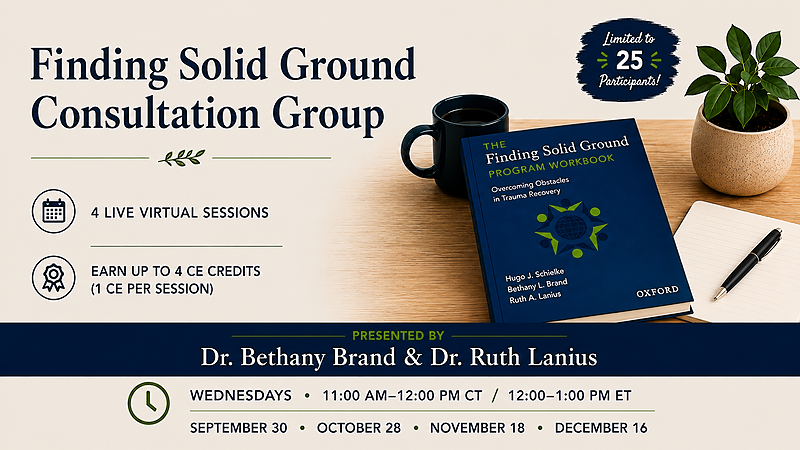
Finding Solid Ground Consultation Group Series
Bundle$400
-
Leading the Way: Helping Clients Heal Through Finding Solid Ground Groups
BundleDiscover how to lead Finding Solid Ground groups, a research-backed program proven to benefit clients with complex trauma and dissociation.
$985
-

Ethics and Finding Solid Ground- 1 CE CREDIT - HomeStudy - Bethany Brand, PhD Ruth Lanius, MD, PhD
CourseFree