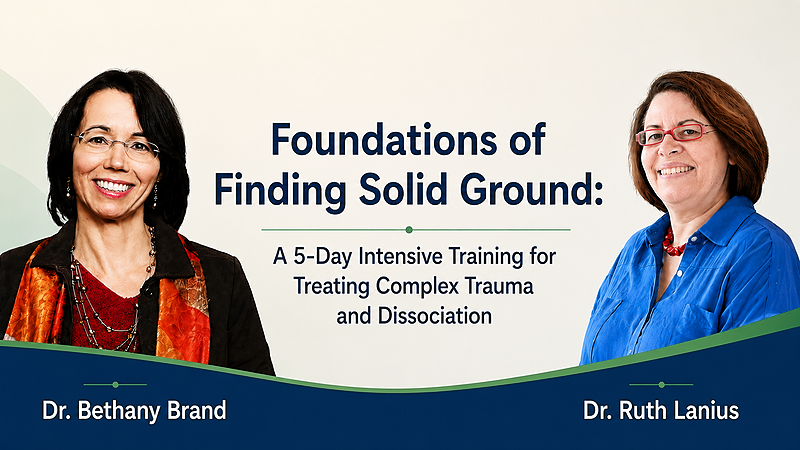
Building the Foundations
Session 1 of the 5-Day Intensive Training for Treating Complex Trauma and Dissociation
Many trauma therapists have experienced it: sessions that feel stuck, clients who seem disconnected or emotionally unreachable, and uncertainty about how to help someone who cannot fully stay present in the room. Dissociation is one of the most common—and most overlooked—barriers to successful trauma treatment, leaving many clinicians feeling frustrated despite their best therapeutic efforts.
This first session of the Finding Solid Ground Intensive Training provides a powerful, neuroscience-informed foundation for understanding and treating complex trauma and dissociation. Finding Solid Ground is the first research-supported intervention shown to improve outcomes for individuals with severe dissociation, providing clinicians with a practical roadmap for addressing one of the greatest challenges in trauma therapy.
Participants will learn how to recognize both obvious and subtle signs of dissociation, understand why many clients struggle to feel grounded and present, and apply practical, evidence-based strategies that can be integrated immediately into virtually any psychotherapy approach. Rather than replacing your current therapeutic model, Finding Solid Ground strengthens it by providing the foundational skills clients need to fully engage in treatment and benefit from deeper therapeutic work.
Through an accessible blend of neuroscience, clinical demonstrations, and practical interventions, this session will help clinicians feel more confident, more effective, and less overwhelmed when working with their most complex clients. Participants will leave with concrete tools for increasing grounding, emotional awareness, and self-compassion while helping clients distinguish past from present and build the stability needed for lasting recovery.
Explain the core principles and structure of the Finding Solid Ground program.
Apply practical grounding strategies to help clients distinguish past from present and increase their capacity for safety and presence.
Understand how trauma reshapes the brain and use neuroscience to guide treatment decisions.
Help clients recognize and work more effectively with trauma-driven thoughts, emotions, and beliefs.
Foster greater emotional awareness, regulation, and self-compassion in clients with complex trauma and dissociation.


5 CE credits available for live attendance & recorded sessions
Bridgepoint Psychology Center (BPC) is co-sponsoring Finding Solid Ground and is approved by the American Psychological Association to sponsor continuing education for psychologists.
You must be in attendance for the full live program or watch the full recording and pass a quiz to receive CE credit. Partial credit will not be available. BPC maintains responsibility for this program and its content.
Please check with your governing board to verify your continuing education license requirements. For additional information regarding CEs, email: [email protected]
Yes, our courses are through APA for continuing education credits. Please check each course description for specific accreditation details.
Upon successful completion of the course and any required assessments, you'll be able to download your CE certificate directly from your account under the "Completed Courses" section.
We provide a CE certificate that includes all necessary details (course title, hours, provider information). Please submit this certificate according to your licensing board’s requirements. It's important to verify your board's guidelines to ensure proper credit reporting.
180 days
While our courses are APA, CE credit requirements vary by state and licensing board. We recommend checking with your specific licensing board to ensure our courses meet their criteria.
You will need a computer or mobile device with internet access, an updated web browser, and in some cases, specific software like Adobe Reader or Zoom for interactive sessions. A stable internet connection is recommended for smooth streaming of video content.