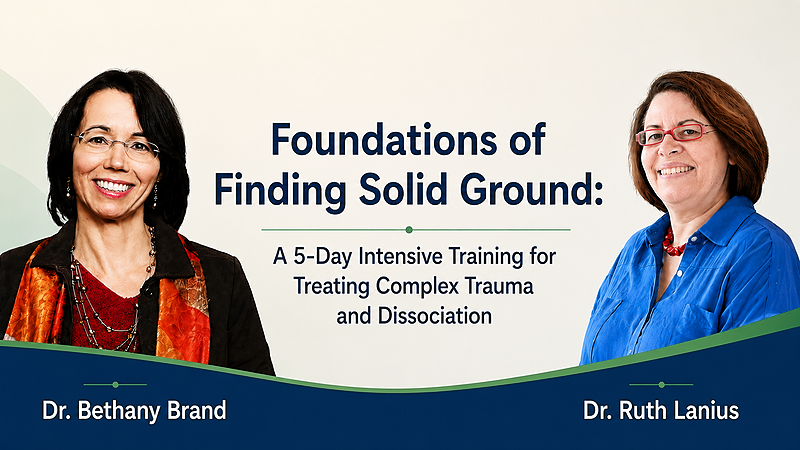
The Restoration of the Self
Session 5 of the 5-Day Intensive Training for Treating Complex Trauma and Dissociation
Why do some trauma survivors fear feeling their emotions more than remembering the trauma itself? Why can simply noticing a heartbeat, muscle tension, or tears feel overwhelming or even dangerous? And how can clinicians safely help clients reconnect with their emotional and bodily experiences without increasing distress or dissociation?
In this final session, participants will bring together the knowledge and skills developed throughout the Finding Solid Ground Intensive Training to address one of the greatest challenges in complex trauma treatment: helping clients safely reconnect with themselves. Clinicians will explore the neuroscience of emotional and somatic avoidance and learn why dissociation often develops as a powerful survival strategy that protects individuals from experiences once perceived as unbearable.
Building on the skills introduced throughout the series, participants will learn practical, evidence-informed interventions for helping clients identify emotions, increase tolerance for bodily sensations, and gradually develop the capacity to experience feelings with greater safety, curiosity, and self-compassion. The session also provides a practical framework for developing individualized Finding Solid Ground safety plans that help clients anticipate and manage periods of increased distress while strengthening resilience and reducing the risk of crisis.
Through engaging clinical role plays and demonstrations, participants will observe practical interventions for working with clients who fear emotions, avoid bodily sensations, or become overwhelmed by positive emotional experiences. The session also provides a basic introduction to leading Finding Solid Ground psychoeducational groups, enabling participants to confidently implement the program in outpatient, inpatient, community, and private practice settings.
As the capstone to the Finding Solid Ground training series, this session brings together the core principles of the model into a flexible, neuroscience-informed framework that can be immediately integrated into virtually any psychotherapy approach. Participants will leave with greater confidence, practical skills, and a research-supported roadmap for helping even their most complex clients reconnect with their bodies, regulate their emotions, and move toward lasting recovery.
This course is meant to be completed within the 5-part series not as a stand-alone course.
Explain why individuals with complex dissociation often fear emotions and bodily sensations and how this maintains trauma-related symptoms.
Apply practical strategies to help clients identify, understand, and tolerate emotions while remaining grounded and regulated.
Demonstrate evidence-informed interventions for working with clients who are afraid of experiencing bodily sensations.
Develop a comprehensive, individualized safety plan using the Finding Solid Ground framework.


5 CE credits available for live attendance & recorded sessions
Bridgepoint Psychology Center (BPC) is co-sponsoring Finding Solid Ground and is approved by the American Psychological Association to sponsor continuing education for psychologists.
You must be in attendance for the full live program or watch the full recording and pass a quiz to receive CE credit. Partial credit will not be available. BPC maintains responsibility for this program and its content.
Please check with your governing board to verify your continuing education license requirements. For additional information regarding CEs, email: [email protected]
Yes, our courses are through APA for continuing education credits. Please check each course description for specific accreditation details.
Upon successful completion of the course and any required assessments, you'll be able to download your CE certificate directly from your account under the "Completed Courses" section.
We provide a CE certificate that includes all necessary details (course title, hours, provider information). Please submit this certificate according to your licensing board’s requirements. It's important to verify your board's guidelines to ensure proper credit reporting.
180 days
While our courses are APA, CE credit requirements vary by state and licensing board. We recommend checking with your specific licensing board to ensure our courses meet their criteria.
You will need a computer or mobile device with internet access, an updated web browser, and in some cases, specific software like Adobe Reader or Zoom for interactive sessions. A stable internet connection is recommended for smooth streaming of video content.